If you run, ride or lift anywhere near Wilmslow, autumn is the busy season. Between early October and late November there is a major half marathon, one of the UK's largest marathons and a string of 10ks, all within easy reach of our door. And if you are training for any of them, recovery deserves the same planning as your long runs.
This is our recovery hub for athletes in and around Wilmslow: the local race calendar, how to build recovery into a training block, which of our three tools to use when — and how to time the ice bath so every session works with your training.
The 2026 race calendar around Wilmslow
These are the races our regulars are training for this autumn and winter.
| Race | Date | The essentials |
|---|---|---|
| ASICS Manchester Half Marathon | Sunday 4 October | Around 31,000 runners; starts and finishes at Old Trafford |
| MBNA Chester Marathon | Sunday 11 October | One of the UK's largest marathons |
| Macclesfield Running Festival | Sunday 18 October | 5k, 10k and half marathon |
| RunTatton Park | Sunday 8 November | Half marathon and 10k |
| Wilmslow Festive 10K | Sunday 22 November | Starts in Wilmslow town centre, minutes from our studio |
| Tatton 10k series | Second weekend of every month | Year-round 10k in Knutsford |
Whichever of these is circled on your calendar, the weeks between now and the start line are where recovery earns its keep.
How to build recovery into a training block
Most training plans are meticulous about the sessions and vague about everything in between. A simple fix is to book recovery the way you book intervals: in advance, on purpose, at the points in the block where it does the most good.
- Easy weeks. Most plans drop the volume every third or fourth week. That down week is the natural home for a contrast session or a float — your body is already primed to absorb the rest.
- After the long run. The biggest sessions of a marathon block are the longest ones. A recovery session that evening or the following day, while your legs are at their heaviest, is where most of our runners put theirs.
- Taper-week floats. The taper is famously hard on the mind — training drops, energy rises, and every twinge feels like a disaster. An hour in a float pod is one of the few places where you genuinely cannot check your watch.
- Race-week sleep. Sleep is the recovery tool all the others are quietly supporting. Guests consistently tell us they sleep deeply on the night of a float, which is why we suggest floating early in race week rather than the night before — bank the good nights while the nerves are still manageable.
The three tools — and when to reach for each
Contrast therapy: for endurance recovery and heavy legs
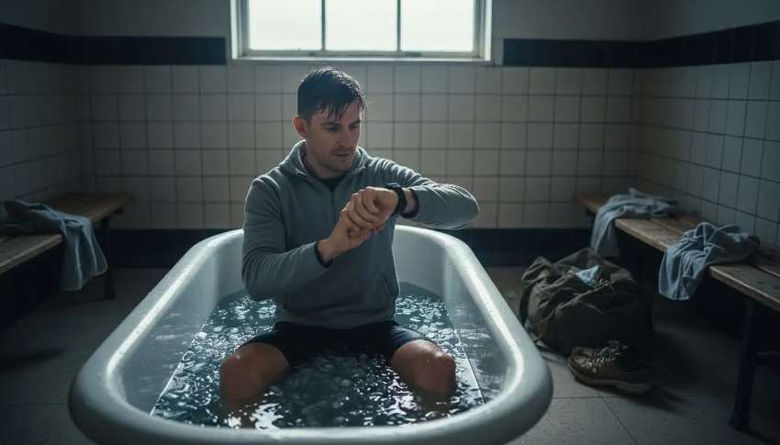
Our contrast sessions alternate an infrared sauna with an ice bath, in a private room, solo or as a duo. This is the tool for the days your legs feel wrecked: after long runs, hilly races and big weekend rides.
If you have ever winced your way downstairs two days after a race, you have met delayed-onset muscle soreness — we have written a plain-English guide to what DOMS actually is and why it peaks when it does. The research on cold and contrast for recovery is genuinely interesting, and we walk through it honestly in our guide to contrast therapy and recovery — but the short version is that many endurance athletes use it after their hardest sessions, and the runners we see tell us their legs feel noticeably fresher the next day.
Float therapy: for the taper, for sleep, and for the space between your ears
A float is 60 minutes in a spacious pod of warm, Epsom-salt-rich water, in a private room with its own shower. You lie back, the water holds you, and for one hour there is no pace, no data and not much gravity to speak of. There is a reason athletes gravitate to Epsom-salt float pods.
We would point you to the pod at two moments in a training block. The first is the taper, when your body needs rest but your head refuses to cooperate. The second is early race week, for the sleep — guests tell us an evening float tends to be followed by a notably deep night. If you want a practical, step-by-step way to build floating into a recovery routine, our guide to using float therapy for recovery and calm covers it.
And a note on the science: floatation and sauna research is promising, with fresh studies emerging every year. We will always say "studies suggest" rather than promise outcomes — what we can vouch for is how our regulars describe it.
Massage with Jade
For hands-on work, massage with Jade rounds out the picture — her deep tissue massage (from £40) is the one most of our athletes choose, now also available as a 90 minute session for heavier training weeks. It is focused, unhurried time on the muscles that have been doing the work, in the same calm rooms as everything else we do.
A word on timing: if you are not used to deep tissue work, keep it away from the final 48 hours before a race — mid-block, or a week or more out, is kinder. And it is worth booking ahead.
The honest bit: when not to ice bath
Here is the timing guidance we share with every athlete, because it makes each session count.
If your session was about building muscle — a strength or hypertrophy workout — do not get in the ice bath straight afterwards. Peer-reviewed research (Roberts and colleagues in the Journal of Physiology, 2015, echoed by a 2024 meta-analysis) suggests that cold-water immersion immediately after strength training can blunt the very muscle-growth adaptations you just trained for.
That does not make the ice bath a bad tool. It makes it a tool with a right time and a wrong time:
- Good times: rest days, after endurance sessions, after races, or several hours after a lifting session once you have given adaptation a head start.
- The time to skip it: immediately after strength or hypertrophy work.
We want every ice bath you take to earn its place in your week. If you are ever unsure where a session fits, ask at reception — we will happily help you time your plunge so it does exactly what you trained for.
The Wilmslow Festive 10K: recovery you can walk to
One race on the calendar deserves a special mention. The Wilmslow Festive 10K on Sunday 22 November starts in Wilmslow town centre, minutes from our door at 82 Chapel Lane. Cross the finish line, get something warm on, and your recovery session is a short walk away — no car park queue, no motorway drive home with your calves seizing up.
We are open until 9pm that Sunday, as we are every day. If you are racing it, book your post-race slot in advance.
The practical bit
A few logistics that make recovery easy to actually do:
- We are open 9am to 9pm, every day — including race-day Sundays, before-work mornings and post-training evenings.
- Book post-race slots ahead. The afternoons after the big October and November races get busy.
- Allow about 90 minutes for a float visit — 60 in the pod, plus time to shower and land gently afterwards.
- Private rooms with showers, and free on-street parking on Chapel Lane and the surrounding roads.
- Intro packs help you build a routine rather than try a one-off. New customers can get three contrast sessions for £90 (saving £30) or three 60-minute floats for £99 (saving £45) — enough visits to thread recovery through a whole training block. And if you have never floated before, here is exactly what to expect.
Train hard, recover deliberately
The fitness you race on is built in the gaps between sessions, and the athletes who last are the ones who plan those gaps as carefully as the work itself. Whether your autumn ends at Old Trafford, in Chester or on a start line minutes from our door, we would be glad to be part of the plan.
You can see everything — floats, contrast sessions, massage, packages and memberships — on our pricing page, with single sessions from £40.