
Legs heavy, joints stiff, and a dull ache setting in hours after a rigorous session—these are unmistakable signs of delayed onset muscle soreness. For athletic professionals pushing limits in Wilmslow and Greater Manchester, managing this temporary condition is not just about comfort, but performance. Understanding how microtrauma and inflammation trigger pain and reduced muscle function empowers you to refine recovery strategies, ensuring you bounce back faster and keep your training momentum.
Key Takeaways
| Point | Details |
|---|---|
| Understanding DOMS | Delayed onset muscle soreness (DOMS) results from microtrauma to muscles during intense or unfamiliar exercise and is a normal part of the body’s adaptation process. |
| Timing and Recovery | Soreness peaks between 24 to 72 hours post-exercise, and effective recovery strategies, including light movement and nutrition, can facilitate faster adaptation. |
| Training Strategy | Gradually introduce new movement patterns and intensities to reduce the severity of DOMS while still promoting muscle adaptation. |
| Myth Busting | DOMS does not indicate severe muscle damage but signifies normal adaptation; therefore, soreness should not deter training. |
Delayed onset muscle soreness explained
You’ve probably experienced it: that distinctive ache that creeps in 24 to 48 hours after a particularly demanding workout. Your legs feel heavy. Stairs become your nemesis. Even getting out of a chair requires genuine effort. That’s delayed onset muscle soreness , or DOMS, and if you’re training seriously in Wilmslow or Greater Manchester, you’ve almost certainly felt its effects. Understanding what’s actually happening in your muscles isn’t just academic—it’s the key to managing recovery effectively and getting back to peak performance.
DOMS emerges from intense or unfamiliar exercise, particularly movements involving eccentric contractions—think lowering weights or running downhill. When your muscles perform work they’re not accustomed to, microscopic damage occurs within the muscle fibres and surrounding connective tissue. This isn’t catastrophic damage; rather, it’s microtrauma that triggers an inflammatory response. The soreness typically manifests between 24 to 72 hours post-exercise, peaks around 48 hours, and gradually subsides over several days. During this window, you’ll notice reduced muscle strength, increased stiffness, and compromised function—exactly what makes those stairs so treacherous.
What makes DOMS particularly interesting is that it’s a temporary condition. Your body isn’t broken; it’s actually adapting. The inflammation that causes the soreness is part of the healing process, not a sign of injury. However, the distinction matters when you’re balancing intense training with recovery demands. Consider these hallmark features of DOMS:
- Muscle soreness and stiffness that worsens before improving
- Reduced range of motion and flexibility
- Temporary loss of strength (up to 50% in severe cases)
- Mild swelling in affected muscles
- Pain that increases during movement, particularly eccentric actions
Here’s where training experience comes into play. Athletes who regularly perform specific movements develop a degree of protection against DOMS for those particular exercises. A Manchester-based footballer, for instance, might experience minimal DOMS from their usual training, but introduce a new strength protocol involving different movement patterns, and DOMS returns. This adaptation is why progressive training remains so effective—your body literally becomes resistant to the soreness response as it becomes more familiar with the demands.
DOMS is temporary and actually signals that your body is adapting to new training stimuli, not that you’ve caused lasting damage. Managing it effectively is crucial for maintaining training consistency.
The inflammation associated with DOMS, whilst uncomfortable, serves a genuine purpose. Your immune system floods the area with cytokines and growth factors, clearing damaged cellular material and initiating repair. This is why proper recovery strategies—whether through movement, contrast therapy, or adequate rest—help accelerate this adaptive process rather than fighting against it. For athletic professionals and serious enthusiasts in Greater Manchester, recognising this distinction transforms how you approach soreness management and training progression.
_Pro tip:_ _When planning training progressions, introduce new movement patterns or intensities gradually rather than jumping directly into maximal efforts; this reduces severe DOMS whilst still providing the adaptation stimulus your body needs._
Symptoms and timing of DOMS
The experience of DOMS varies wildly from person to person, but the pattern remains remarkably consistent. You’ll wake up the morning after an intense session feeling relatively fine, then by afternoon—or more commonly by the next morning—your muscles begin to rebel. That’s not a coincidence. DOMS follows a predictable timeline, and understanding when symptoms peak and how they progress helps you plan your training and recovery strategically.
The soreness itself presents as a dull, aching pain rather than sharp or acute discomfort. Your muscles feel tender to the touch, and movement triggers the worst of it. Unlike an acute injury where pain dominates at rest, DOMS typically worsens during muscle stretching or contraction. This distinction matters because it tells you the damage is muscular rather than structural. Symptoms typically begin within 12 to 24 hours after exercise, which is why you might feel almost normal immediately post-workout but struggle with basic movements the following day. The soreness peaks between 24 to 72 hours—usually around the 48-hour mark—before gradually subsiding over the following week.
Beyond the aching sensation itself, DOMS presents with several accompanying symptoms that compound the discomfort:
- Reduced muscle strength (sometimes up to 50% loss in severely affected muscles)
- Stiffness and reduced range of motion
- Mild swelling in the affected area
- Muscular tenderness when pressure is applied
- Increased sensitivity to pain during movement (mechanical hyperalgesia)
The timeline varies slightly depending on exercise intensity, your training age, and which muscle groups are affected. Larger muscles like your quads and glutes tend to experience more pronounced soreness than smaller stabiliser muscles. A sprinter in Manchester might recover from leg DOMS within five days, whilst someone new to eccentric training might still feel significant soreness into day seven. For serious athletes, recognising this progression helps distinguish between DOMS and actual injury, which remains one of the most valuable skills in managing your training.
Soreness peaks around 48 hours post-exercise and typically subsides within 3 to 5 days, though full recovery of muscle function may take longer in some cases.
What’s crucial to understand is that recovery timelines vary considerably based on training status. Your body becomes more efficient at managing the inflammatory response once it’s familiar with specific movements. The first time you perform a particular eccentric exercise pattern, DOMS hits harder and lasts longer. By the fifth or tenth repetition of that same movement, your body’s adaptation means soreness reduces significantly. This adaptation is why periodically introducing new training stimuli produces DOMS, whilst your regular training rarely does.
The biochemical markers of muscle damage—elevated creatine kinase and myoglobin—actually peak before soreness becomes noticeable, sometimes appearing within hours of exercise. This means your body is already beginning repair when you’re still feeling fine. The soreness you experience is largely the inflammatory response, not the damage itself. This timing explains why active recovery strategies work: light movement actually enhances blood flow to damaged tissue and accelerates the clearance of inflammatory byproducts.
For athletic professionals balancing multiple training demands, the 24 to 72-hour window is critical. Scheduling intense lower-body work when you’re fresh, not when residual DOMS is still compromising strength, makes physiological sense. Similarly, knowing that soreness improves after day three allows you to schedule demanding sessions knowing recovery will be progressing towards full function.
_Pro tip:_ _Log the timing and intensity of DOMS following different training sessions; you’ll quickly identify which movement patterns cause significant soreness in your body, allowing you to plan recovery days strategically around your competition or peak training phases._
Causes and mechanisms behind DOMS
Understanding why DOMS happens requires looking at what actually occurs inside your muscles when you train. It’s not simply inflammation or lactic acid buildup, as older theories suggested. The reality is more nuanced and, frankly, more interesting. When you perform eccentric contractions—lowering a weight, descending stairs, or decelerating during sprints—your muscles experience mechanical stress that goes beyond what they’re adapted to handle. This stress triggers a cascade of events that unfolds over hours, ultimately resulting in the soreness you feel.
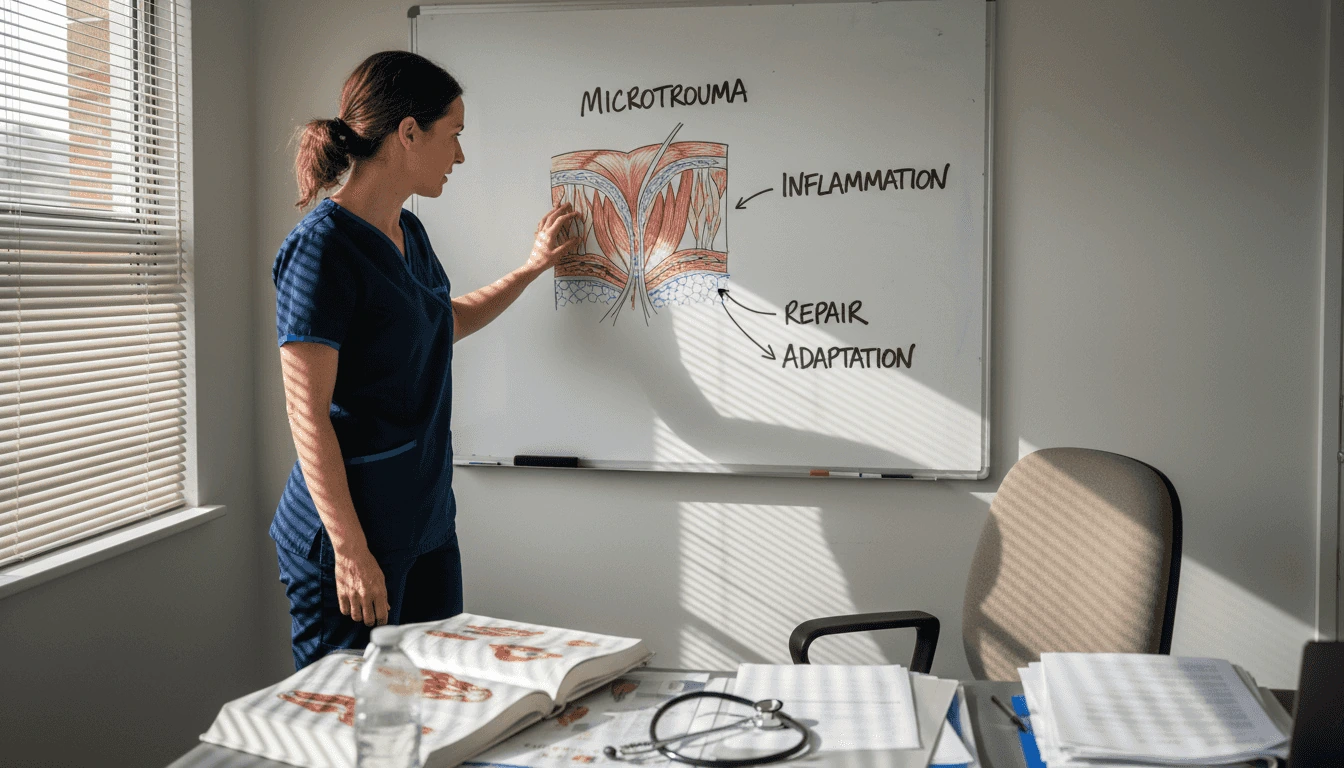
The primary culprit is microtrauma to muscle fibres and connective tissue. Mechanical damage from eccentric contractions creates microscopic tears within the muscle structure and the fascia surrounding it. Think of it like minor wear and tear on a rope; the rope isn’t severed, but individual fibres are disrupted. This mechanical damage doesn’t directly cause pain—instead, it initiates a biological response. Your immune system detects the damage and floods the area with inflammatory chemicals, cytokines, and growth factors. These signalling molecules activate pain receptors, a process called nociceptor sensitisation , which is why you feel soreness even though the actual structural damage is relatively minor.
The progression involves several interconnected mechanisms working simultaneously:
- Calcium influx into damaged muscle cells disrupts normal cellular function
- Inflammatory mediators activate and sensitise pain receptors in the area
- Metabolic byproducts accumulate as cells struggle to maintain normal function
- Swelling develops as fluid accumulates in the tissue space
- Growth factors trigger protein synthesis needed for repair and adaptation
The efflux theory adds another layer to this understanding. When muscle cells are damaged, calcium floods in from outside the cell because the damaged membrane can no longer regulate ion balance properly. This calcium accumulation leads to further metabolic disturbances; enzymes that shouldn’t be active become hyperactive, and cellular structures begin breaking down. This cascading effect extends the inflammatory window and contributes to the delayed nature of soreness. It’s not the initial damage causing pain—it’s the body’s response to that damage over the subsequent 24 to 72 hours.
The soreness you experience is your immune system’s response to microtrauma, not the mechanical damage itself, which is why soreness peaks hours after the initial damage occurs.
What makes this particularly relevant for serious athletes is recognising that microstructural damage triggers inflammation that’s actually beneficial. The inflammatory response isn’t your enemy; it’s your body’s adaptation mechanism. The chemicals flooding the area—particularly growth factors and cytokines—signal your muscle cells to rebuild stronger and more resistant to future similar stress. This is why DOMS becomes less pronounced with repeated exposure to the same stimulus. Your body learns to manage the stress more efficiently, reducing both the initial damage and the inflammatory response.
Eccentric contractions cause greater microtrauma than concentric contractions because your muscles are actively lengthening under tension. Imagine trying to hold back a heavy object being lowered; your muscles are fighting against external force while being stretched. Concentric contractions, by contrast, involve shortening under tension, which generates less mechanical stress. This is why running downhill produces more DOMS than running on flat ground, and why the lowering phase of any lift causes more soreness than the lifting phase.
The metabolic overload component matters too. During intense eccentric exercise, your muscles can’t produce energy quickly enough to match the demands, creating an energy deficit. This metabolic stress, combined with mechanical strain, amplifies the inflammatory response. Your system essentially enters a recovery mode, prioritising repair over performance—which is precisely why proper recovery strategies become crucial during this window.
_Pro tip:_ _To minimise severe DOMS whilst still gaining adaptation benefits, gradually increase the eccentric load or volume in new movement patterns over 3 to 5 sessions rather than jumping to maximal intensity immediately; this allows your connective tissue to adapt alongside your muscle fibres._
Common misconceptions and facts
Soreness myths persist stubbornly in fitness culture, even among experienced athletes. You’ve probably heard someone claim that DOMS means you’ve damaged your muscles severely, or that the soreness indicates poor recovery. These narratives, whilst seemingly logical, don’t match what research actually shows. Separating fact from fiction matters because it directly influences how you approach training and recovery. Acting on misconceptions can lead to unnecessary caution, missed training opportunities, or conversely, pushing through legitimate warning signs.
The most persistent myth is that lactic acid buildup causes DOMS. This idea has been repeated so often it feels like established fact. The reality? Lactic acid clears from muscles within an hour post-exercise and has virtually nothing to do with soreness that emerges 24 to 72 hours later. During intense exercise, your muscles produce lactate as a byproduct of energy metabolism. This lactate is rapidly cleared once you stop exercising, returning to normal levels within 60 minutes. Yet DOMS doesn’t peak until 48 hours. The timeline simply doesn’t match. This myth persists because soreness and lactate both occur during or immediately after training, creating a false association. Understanding this distinction changes everything about how you interpret your post-workout experience.
Another widespread misconception is that soreness directly correlates with muscle damage that impairs training. Many athletes believe DOMS is a sign they’ve injured themselves and need to back off training. The opposite is closer to reality. DOMS primarily signifies normal adaptation and repair processes that enhance muscle strength over time. The soreness isn’t your body saying “stop training this muscle”—it’s saying “your body is responding and adapting to this stimulus.” You can experience significant DOMS and still be in a perfectly healthy adaptation state. Conversely, you can have minimal DOMS yet still achieve substantial training stimulus. Soreness isn’t a reliable measure of training effectiveness.
A critical distinction often blurred is the difference between DOMS and exercise-induced muscle damage (EIMD). These terms are related but fundamentally different. DOMS refers specifically to soreness perception, whilst EIMD entails structural damage. EIMD is actual damage visible under a microscope—torn sarcomeres, disrupted Z-discs, and damaged contractile proteins. DOMS, by contrast, is largely neurophysiological; it’s your nervous system’s perception of that underlying damage filtered through inflammatory signals. They occur together but aren’t synonymous. You can have EIMD without significant DOMS, and whilst less common, you can have DOMS without measurable structural damage in some cases.
DOMS is not a direct measure of injury or training effectiveness, but rather a normal part of adaptation to novel or intense exercise stimulus.
Here’s what the research actually supports:
- DOMS becomes progressively less pronounced with repeated exposure to the same movement pattern
- DOMS doesn’t prevent training the same muscles again, though strength may be temporarily reduced
- Soreness severity doesn’t correlate reliably with strength gains or muscle growth
- DOMS is temporary and self-limiting, resolving within 7 days in most cases
- Eccentric exercise produces more DOMS than concentric work, but both provide training stimulus
Some athletes worry that DOMS indicates they’re not recovering properly. This misses the point. DOMS is what happens when your body encounters a novel stimulus—it’s adaptation in action. A sprinter changing to hill sprints will experience significant leg DOMS the first session, minimal DOMS by the fifth session, despite continuing the same training. That’s progression, not poor recovery. Recovery quality is about returning to baseline strength and reducing inflammation, not eliminating soreness entirely.
One final misconception worth addressing: that soreness must be minimised at all costs. Some athletes chase recovery techniques obsessively, trying to eliminate DOMS completely. Whilst managing soreness is reasonable for performance during competition, some level of soreness from novel stimuli is simply the cost of adaptation. Attempting to eliminate it entirely means avoiding the training stimulus that drives improvement. The goal is managing DOMS strategically, not eradicating it.
_Pro tip:_ _When introducing new training phases or movement patterns, expect DOMS as a normal signal of adaptation rather than alarm; use the soreness timeline to schedule subsequent sessions strategically rather than letting soreness determine whether you train._
Risks, impact on performance, and recovery
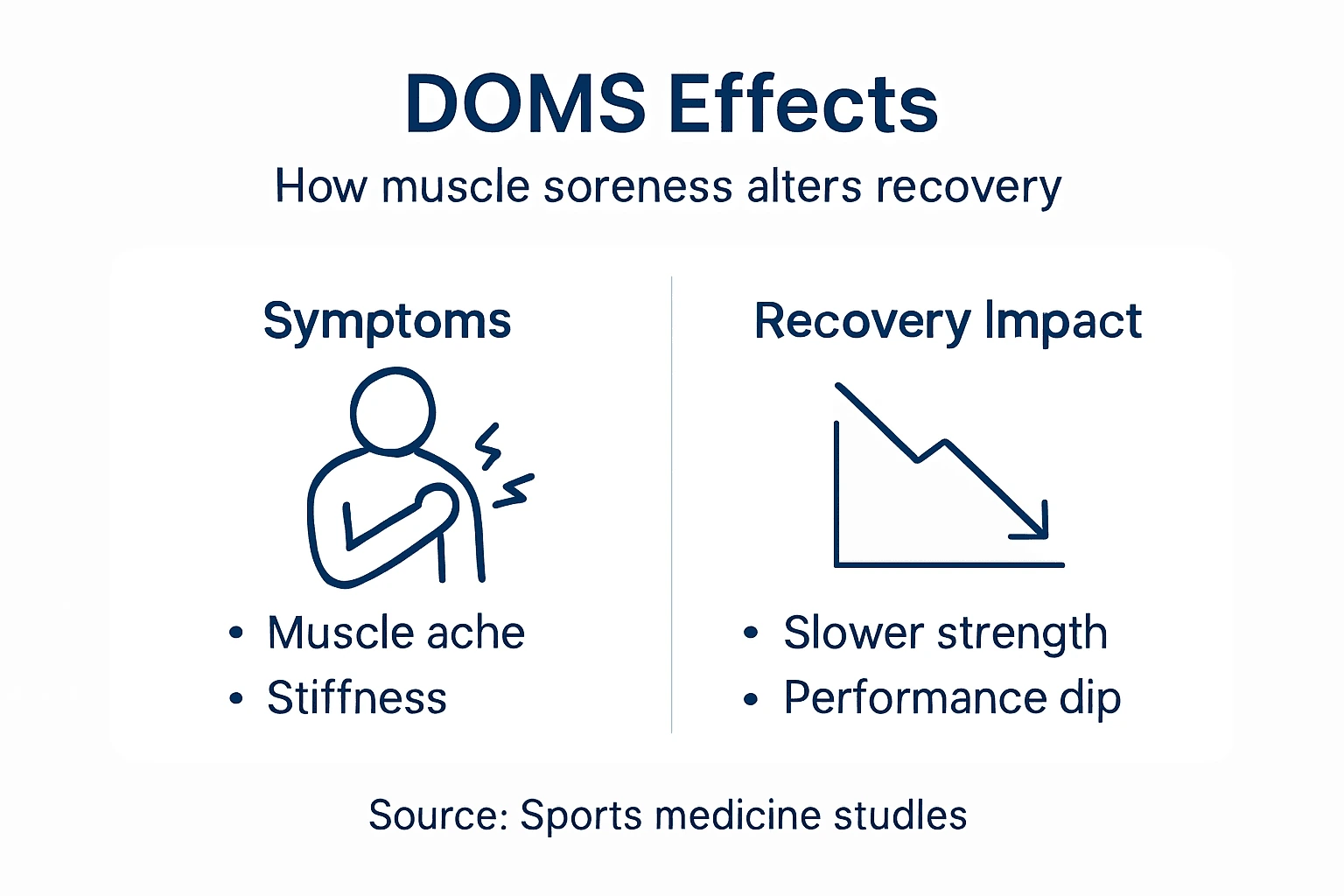
Whilst DOMS itself isn’t dangerous, the temporary strength loss it causes carries genuine performance implications. During the peak soreness window—24 to 72 hours post-exercise—your muscles operate at reduced capacity. A footballer might lose 30 to 50 per cent of leg strength whilst managing DOMS from a new training protocol. This isn’t imaginary; it’s measurable and immediate. Understanding these performance effects matters because it shapes how you schedule training and competition. Ignoring DOMS-related strength deficits increases injury risk substantially, particularly when performing demanding movements whilst already compromised.
DOMS temporarily reduces muscle strength and joint range of motion, creating vulnerability during the soreness peak. Your neuromuscular system struggles to recruit muscle fibres efficiently when inflammation and pain sensitise the area. Additionally, reduced range of motion increases reliance on compensatory movement patterns. A runner with tight, sore quads might alter their gait subtly, placing extra stress on knees, hips, or ankles. These compensation patterns introduce secondary injury risk —you might injure an adjacent joint whilst avoiding discomfort in the sore muscle. This is why training around DOMS strategically matters far more than pushing through it.
The performance impact varies with training context:
- Strength and power activities suffer most during peak DOMS (48 hours post-exercise)
- Explosive movements lose efficiency faster than steady-state activities
- Large muscle groups show greater strength deficits than smaller stabiliser muscles
- Previously adapted movements cause minimal performance loss even with soreness
- Novel movement patterns produce both soreness and significant strength reduction simultaneously
Here’s the critical distinction: DOMS itself doesn’t cause lasting damage. You recover completely within days. However, training intensely whilst severely sore, particularly with novel movements, risks compounding the initial damage. If you’ve induced DOMS from eccentric leg work and then attempt maximal leg strength training 24 hours later, you’re asking damaged, inflamed muscles to handle peak loads before they’ve stabilised. This multiplies injury risk disproportionately. The risk isn’t DOMS—it’s training poor movement patterns or maximal loads whilst already compromised.
DOMS itself resolves without lasting damage, but the temporary strength loss increases secondary injury risk if demanding training continues without modification.
Recovery from DOMS involves restoration of both inflammatory markers and muscle contractile function. The presence of DOMS affects muscle function and impairs strength, and recovery requires reducing inflammation whilst restoring normal muscle properties. This takes a little time, and it responds best when you support recovery from several angles at once. Active strategies—light movement, proper nutrition, adequate sleep—accelerate the process more effectively than complete rest. However, completely avoiding the sore muscle group isn’t the solution either. Gentle, pain-free movement actually enhances blood flow to the area and speeds clearance of inflammatory byproducts.
One often-missed factor: delayed recovery or neglecting appropriate rest increases overuse injury risk. If DOMS from Monday’s leg session hasn’t resolved by Wednesday, training legs again at full intensity Wednesday risks turning temporary soreness into chronic inflammation. Your body needs time to complete the adaptation cycle. This doesn’t mean inactivity; it means intelligent training selection. You can maintain fitness without loading the already-compromised tissue. A footballer might perform upper-body strength work, skill drills without heavy eccentric loading, or aerobic work whilst waiting for leg DOMS to resolve.
For athletic professionals in Wilmslow managing multiple training demands, the recovery window is critical. Track which training stimuli produce significant DOMS, then schedule subsequent high-demand sessions on muscle groups that aren’t currently sore. This prevents layering multiple soreness cycles and maintains performance consistency. Contrast therapy—alternating heat and cold exposure—can facilitate recovery without requiring time away from training. The heat promotes blood flow and tissue healing, whilst cold reduces inflammation and pain, creating an optimal environment for adaptation.
The table below summarises how DOMS impacts performance and risk:
| Training Factor | DOMS Effect | Performance Impact |
|---|---|---|
| Strength | Temporary loss (up to 50%) | Reduces maximal output |
| Range of motion | Noticeably decreased | Affects technique efficiency |
| Injury risk | Slightly increased | Compensatory movements common |
| Recovery speed | Slowed during peak soreness | Demands strategic scheduling |
_Pro tip:_ _When DOMS peaks (around 48 hours), substitute high-intensity or novel movements with lighter variations or different muscle groups; this maintains training momentum whilst allowing damaged tissue to stabilise before re-loading, reducing secondary injury risk substantially._
Effective management and prevention strategies
Managing DOMS effectively means combining prevention with active recovery strategies that actually work. The best approach isn’t passive rest or pushing through soreness—it’s strategic intervention at multiple points. For serious athletes in Wilmslow and Greater Manchester, understanding which strategies deliver genuine results versus which merely feel good matters for training consistency. Physiotherapeutic interventions such as massage therapy, cold-water immersion, and vibration therapy have all been shown to help reduce pain and accelerate functional recovery. The key is matching the right strategy to your training phase and recovery timeline.
Prevention begins with progressive training progression. This isn’t complicated: gradually increase intensity, volume, or novelty rather than jumping to maximal effort immediately. When introducing new movement patterns, your connective tissue needs adaptation time alongside your muscle tissue. Start a new eccentric-heavy protocol at 60 to 70 per cent intensity, then progress by 10 to 15 per cent weekly. This allows your body to develop protective mechanisms against DOMS whilst still providing sufficient stimulus for adaptation. Avoiding sudden bouts of eccentric overload is one of the most effective DOMS prevention strategies available, yet it’s constantly overlooked in pursuit of rapid progress.
For active management during the DOMS window, consider this hierarchy of interventions:
- Light movement and mobility work (highly effective, immediately accessible)
- Massage or soft tissue mobilisation (reduces pain and stiffness significantly)
- Cold-water immersion or ice baths (reduces inflammation and pain perception)
- Vibration therapy (enhances blood flow and recovery speed)
- Contrast therapy (combines heat and cold for optimal inflammatory response)
- Electrical stimulation (accelerates muscle function recovery)
Not every strategy suits every situation. Cold-water immersion works brilliantly for reducing acute inflammation and delivers its best results when used strategically within your training week. Contrast therapy—alternating between heat and cold—offers advantages over cold alone because the heat promotes blood flow and tissue healing whilst cold reduces swelling and pain. For athletic professionals managing training frequency, contrast therapy delivers recovery benefits without requiring time away from training. A session alternating between a heated infrared sauna and a cold plunge pool, maintained at 7°C, creates optimal conditions for clearing inflammatory byproducts and preparing tissue for subsequent training.
Progressive training progression is the most effective DOMS prevention strategy, reducing both incidence and severity whilst maintaining adaptation stimulus.
Massage therapy deserves particular attention for Wilmslow-based athletes. Regular massage reduces muscle stiffness, enhances range of motion, and accelerates recovery between sessions. The mechanism works through increasing blood flow, reducing muscle tension, and potentially modulating pain perception through gate control mechanisms. A 10 to 15-minute massage session during the DOMS peak produces measurable improvements in function. Unlike interventions requiring specialised equipment, massage remains accessible and can be self-administered through foam rolling or massage guns, though professional massage offers superior results.
Preventing DOMS involves a multifaceted approach incorporating contrast therapy, cooling methods, and massage alongside structured training progression. The reality is that no single intervention eliminates DOMS entirely—nor should you want it to. Some soreness indicates appropriate training stimulus. Instead, combine strategies to minimise excessive soreness whilst maintaining adaptation benefits. This might look like: introducing new movements progressively, performing light active recovery work on sore days, scheduling massage or contrast therapy at strategic points, and ensuring adequate sleep and nutrition to support the inflammatory response.
Here’s a quick comparison of common DOMS management strategies and when to use them:
| Method | Best Use Phase | Key Benefit |
|---|---|---|
| Light movement | 24–72 hours post-workout | Promotes blood flow for recovery |
| Massage therapy | Peak soreness | Reduces muscle stiffness |
| Cold-water immersion | Immediately post-exercise | Decreases inflammation and pain |
| Contrast therapy | 24–48 hours post-exercise | Accelerates inflammatory clearance |
| Vibration therapy | Any recovery day | Enhances circulation and healing |
For practical application, categorise your training into three types: maintenance work (movements your body knows well), development work (familiar patterns at higher intensity), and novel work (new movements or patterns). Novel work produces inevitable DOMS; manage it through progressive introduction. Maintenance and development work should be scheduled when residual soreness doesn’t compromise performance. Contrast therapy between training sessions accelerates recovery without requiring inactivity, making it ideal for athletes managing multiple sessions weekly.
Nutrition and sleep amplify all other recovery strategies. Your body completes the inflammatory response and protein synthesis that drives adaptation primarily during sleep. Protein availability influences the speed of adaptation and tissue repair. Carbohydrates replenish muscle glycogen, supporting both performance and inflammatory signalling. Inadequate nutrition or sleep sabotages every other recovery intervention, so these fundamentals must come first.
_Pro tip:_ _Introduce a contrast therapy session (alternating between warm and cold exposure) within 24 to 48 hours of novel high-intensity eccentric work to accelerate inflammatory clearance and maintain training consistency without allowing soreness to accumulate across multiple sessions._
Manage Delayed Onset Muscle Soreness with Advanced Recovery Solutions
Delayed onset muscle soreness presents a significant challenge for athletes and fitness enthusiasts who want to maintain consistent training without sacrificing performance or risking injury. This article highlights the crucial window of 24 to 72 hours where inflammation peaks and muscle strength is temporarily reduced. Understanding that this soreness is part of the adaptation process is essential but managing it effectively requires more than rest alone. Key pain points include persistent muscle stiffness, temporary strength loss, and the increased risk of compensatory injuries during this recovery phase.
At Float Therapy Wilmslow, we specialise in scientifically supported recovery methods tailored to accelerate the inflammatory clearance that causes DOMS. Our dedicated contrast therapy suite leverages the power of heat and cold exposure through a high-performance infrared sauna and a cold plunge pool maintained at 7°C. This combination reduces inflammation, enhances blood flow, and speeds up muscle repair. Complement this with our sensory deprivation float pods where deep relaxation promotes mental restoration and supports physical recovery from the demanding effects of intense training. Embrace a holistic, evidence-based approach to DOMS management and ensure you return to peak performance faster.
Experience the benefits of expert recovery protocols designed specifically for the challenges of delayed onset muscle soreness. Take action now to avoid layering soreness cycles and reduce injury risk by booking your session at Float Therapy Wilmslow. Discover how contrast therapy and flotation can transform your recovery and keep your training on track.
Frequently Asked Questions
What causes delayed onset muscle soreness (DOMS)?
DOMS is primarily caused by microtrauma to muscle fibres and connective tissues during intense or unfamiliar exercise, particularly eccentric contractions like lowering weights.
How long does DOMS typically last?
DOMS usually begins within 12 to 24 hours after exercise, peaking around 48 hours, and generally subsides within 3 to 5 days, though some individuals may experience soreness for up to a week.
How can I manage or reduce the effects of DOMS?
Effective management of DOMS involves progressive training, light movement, and active recovery strategies such as massage therapy, cold-water immersion, or contrast therapy to facilitate recovery while allowing the body to adapt.
Is DOMS a sign of muscle damage or poor recovery?
No, DOMS is not a sign of severe muscle damage or poor recovery; rather, it indicates that your body is adapting to new training stimuli. It is a normal part of the muscle repair process following exercise.
Keep reading: Why Athletes Use Epsom Salt Pods for Recovery