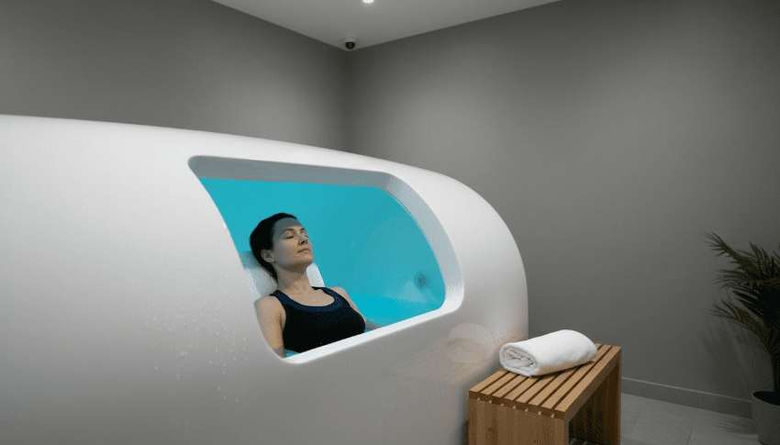
"Is it claustrophobic?" is the question we're asked more than any other — usually somewhere near the end of a phone call, in a slightly apologetic tone, as if it were a silly thing to worry about. It isn't. If the thought of lying in an enclosed pod makes your chest tighten a little, that's a perfectly reasonable reaction to the idea of a float tank. So this page takes the worry seriously and answers it properly.
Here's our starting position: floating is not something you have to brave. At Float Therapy Wilmslow, every part of the session is designed so that you — not the pod, and not us — stay in control from the moment you arrive to the moment you leave.
The honest short answer
Most guests tell us floating doesn't feel claustrophobic at all. But we'd never wave the concern away with a breezy "you'll be fine", because nobody can honestly promise how you'll feel. What we can promise is this: the pod is not a sealed capsule. You choose whether the lid is open, ajar or closed, for as much of the session as you like. The door never locks, and you can sit up and step out at any moment, for any reason, without explaining yourself to anyone.
Plenty of guests who arrive unsure about enclosed spaces float happily with the lid open. Plenty more start that way and close it a few visits in, once it feels like their idea rather than ours. And some never close it at all, and enjoy floating just as much. There is no right way to do it.
What people imagine versus what's actually there
When people picture a "sensory deprivation tank", they tend to imagine something between an MRI scanner and a submarine hatch: narrow, rigid, sealed shut. The reality is nothing like that.
A float pod is an open pool of warm water, so rich in Epsom salt that your body rests effortlessly at the surface. You step in, sit down, lie back, and the water simply holds you. If you've read our explainer on what sensory deprivation actually is, you'll know the point was never confinement — it's the gentle removal of light, sound and gravity so your body and mind can properly rest. In a float pod, darkness is something you choose, not something imposed on you.
And here's the part almost nobody expects. Time and again, guests step out and tell us some version of the same thing:
It feels bigger on the inside than it looks from the outside.
With the lid down there are no walls to see and nothing pressing against you, so your brain has very little to register as "enclosed". Many guests say the space seems to open out rather than close in. We can't promise you'll feel that way — but it's striking how often people do.
How much control you actually have
It's worth being specific here, because this is the part that matters most:
- The lid can stay open. Completely, for the whole session, every visit. Floating with it up is every bit as valid as floating with it closed.
- The door never locks. Ever, on any visit, at any point in your session. You can open it whenever you like.
- The room is entirely yours. Each float room is private, with its own shower. Nobody else comes in — which is also why most guests float without clothing. Complete privacy is part of the design.
- You can get out whenever you like. The 60 minutes in the pod are yours. Sit up, step out, take a breather, get back in — or call it a day. Nobody is timing your nerve.
- You'll be shown everything first. We talk every first-timer through the room, the pod and how it all works before leaving you in peace. Many of our guests are complete first-timers; you won't be the first nervous one we've met, and you won't be the last.
If you're nervous, here's what tends to work
Guests who arrived unsure have taught us a lot over the years. These are the approaches they reach for most:
- Start with the lid open or ajar. Many first-timers float their whole first session with the lid up, or resting slightly open. The water works exactly the same either way.
- Remember the water does the work. There's nothing to concentrate on, no position to hold and nothing to get right — the Epsom-salt-rich water keeps you at the surface on its own. Knowing there's no technique to master takes a surprising amount of pressure off.
- Treat the first ten minutes as an experiment. Rather than committing to an hour in your head, just get in and see how it feels. Most guests find the nerves fade far faster than they expected once the water takes their weight, and the rest of the session takes care of itself.
- Come back to your breath. If a flicker of unease shows up, guests often find a few long, slow breaths out are enough to let it pass. The stillness of the water makes this easier than it sounds.
It also helps to arrive unrushed. A float is 60 minutes in the pod, but we suggest allowing around 90 for the visit, so there's time to settle in and shower rather than hurrying straight from the car. You'll find more small, sensible tips in our guide to preparing for a float naturally, and our companion piece on your first float walks through the whole visit step by step, so nothing on the day comes as a surprise.
What unsure guests tell us afterwards
There's a pattern we see week in, week out. Someone books while quietly resolving never to close the lid. They float their first session open. Then, somewhere in a later visit, they close it — on their own terms, in their own time — and come out slightly amazed at themselves.
Others keep it open every single time and love their floats just as much. Both count as success stories to us.
Among our 350+ five-star reviews, one of the most common threads is surprise: people who arrived braced for something intense and found something gentle instead. Guests tell us the hour passes far more quickly than they expected, and many who felt unsure beforehand say floating turned out to be one of the calmest things they'd done in years.
To be clear about what we are and aren't saying: floating is not a treatment for claustrophobia, and we'd never present it as one. If a fear of enclosed spaces significantly affects your life, that's a conversation for your GP rather than a float studio. What we can honestly offer is an environment built around comfort and control — and the experience of many guests who arrived unsure and settled in far more easily than they expected.
A quick word on health
A few conditions deserve a conversation with your doctor before you book: epilepsy, heart conditions, asthma, skin conditions, allergies, very low blood pressure and certain mental health conditions. If you're pregnant, floating may suit earlier pregnancy, but we don't recommend it beyond 35 weeks.
On the practical side, give the salt a little respect: avoid floating with freshly shaved or waxed skin, fresh hair dye, false tan or a very new tattoo. Our FAQs cover these and most other common questions in more detail.
Come and have a look
If you're still on the fence, you don't have to decide from behind a screen. Call us on 07810 145975 and ask anything at all — we're open 9am to 9pm every day at 82 Chapel Lane in Wilmslow, with free on-street parking nearby, and we're always glad to talk a nervous first-timer through exactly what to expect.
When you're ready, a single float is £48, and new customers can start with our Intro to Float Therapy pack — three 60-minute floats for £99 — which many people use to ease in gradually over a few visits. Everything is on our pricing page.
And whichever way you float, the lid will be exactly where you want it. That part is always up to you.