Roughly 13 million women in the UK are perimenopausal or post-menopausal right now — about a third of the female population. Between 80 and 90 per cent of them experience symptoms, and for around one in four, those symptoms are severe. That is not a small or fringe experience. It is one of the most common things happening in the country, and it still gets brushed aside, joked about or quietly endured far more often than it gets taken seriously.
So let us start by taking it seriously. If your sleep is in pieces, if your body has become unpredictable, if you are holding down work and family and everything else while feeling like a stranger to yourself — that is hard, and you are not imagining it.
This page is not about fixing any of that. We are a float and recovery studio in Wilmslow, not a clinic, and nothing we do treats menopause. What we can offer is smaller and, many women tell us, genuinely valuable: an hour that is completely yours. Quiet, warm or cold as you choose, weightless if you like, with nobody asking anything of you. Here is why that kind of rest gets harder to find during menopause — and how to explore it gently.
Why rest gets harder exactly when you need it more
There is a cruel arithmetic to this stage of life. It asks more of you — physically and emotionally — at precisely the moment it takes away the thing that would help you cope: proper rest.
Sleep is often the first casualty. Many women describe waking at three in the morning, too hot, then too cold, then simply awake — lying in the dark while a mind that will not switch off reviews every worry it can find. The night ends before it feels like it began, and the day still has to be done.
Then there is temperature. A body that used to regulate itself quietly now runs hot and cold without warning, which makes it hard to trust — hard to relax into a warm bath, a duvet, a meeting room, your own skin.
And underneath both sits the mental noise. Guests often tell us the hardest part is not any single change but the sense of never being off duty: the lists, the vigilance, the feeling that rest has become one more thing to fail at.
None of this needs a label, and we are not going to give it one. But it explains why so much menopause self-care advice lands badly — it tends to arrive as another list of jobs. Rest should not be a task. Sometimes what helps is simply giving it a time, a place and a door that closes.
What the cold-water research actually says
You may have seen headlines about cold-water therapy and menopause. Here is the honest version.
In 2024, a UCL-led survey published in Post Reproductive Health asked 1,114 women — 785 of them menopausal — about cold-water swimming. Among those surveyed, cold-water swimming was reported to be associated with improvements in:
- anxiety — 46.9 per cent of respondents
- mood swings — 34.5 per cent
- low mood — 31.1 per cent
- hot flushes — 30.3 per cent
Two things worth knowing about that research. First, this was a self-report survey, not a clinical trial — it tells us what women said they experienced, not what the cold was proven to do, and some of the benefit may come from the exercise, the outdoors or the company rather than the water. Second, it studied outdoor swimming, not ice baths. So we would call it promising early research — well worth knowing about, and encouraging for anyone curious.
Why mention it at all? Because a lot of women in that survey clearly felt deliberate cold gave them something, and that is an experience you can explore here gently, privately and on your own terms — no lake at dawn required. Our contrast therapy suite pairs an infrared sauna with an ice bath in a private room, and sessions can be booked solo, so you can try the cold for thirty seconds, three minutes, or not at all.
Floating: weightless rest when sleep is broken
Floating is the quietest thing we offer, and for many women it is the right place to start.
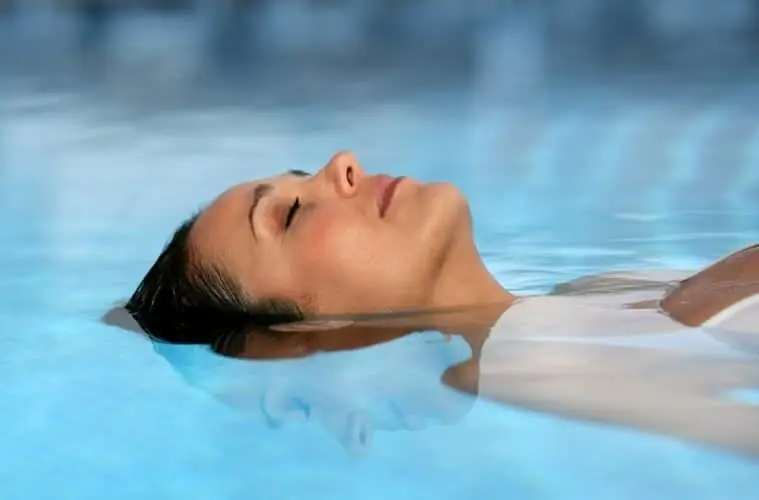
A float session is sixty minutes in a spacious pod of warm water so rich in Epsom salt that your body floats without any effort. The water sits close to skin temperature, so the edges of you soften; the lights and any music are entirely under your control, and most people end up in darkness and silence — weightless, with nothing to hold up and nothing to do. Allow around ninety minutes for the whole visit, including your own private room and shower.
We are careful with our words here: floating does not treat anything, and we cannot promise you a good night afterwards. What we can say is that guests regularly describe drifting into a deeply drowsy, dream-adjacent state in the pod — and that when your nights are broken, an hour of genuine stillness is not a luxury. It is rest you were owed and never got. If sleep itself is the battle, our guide on how to fall asleep faster covers the evening habits that help and where a float can fit around them.
Never floated before? Here is exactly what to expect, including the practical details people often ask about — from hair washing to what happens if you want to get out early. (You can, at any time. The hour is yours to use however you like.)
Warm, cold and finding what works for your body
One thing menopause makes very clear is that your body's relationship with temperature is yours alone — and it may have changed.
Some women find deep, dry warmth is the thing. The infrared sauna warms you gently rather than filling the room with scalding air, and many guests find it a kinder sort of heat — warmth on purpose, for once, rather than warmth ambushing you. Others discover the cold is the revelation: a short, chosen immersion that ends in a strange, bright calm. Plenty of people love the alternation itself — warm, cold, warm again — and simply want to see how their body answers.
There is no correct answer, and we will never tell you there is. Contrast sessions run in a private suite, at your own pace, with nobody watching or timing you. Thirty seconds in the ice bath counts. So does zero. The point is not endurance; it is spending an hour actually listening to what your body wants — which, many women tell us, is a quietly moving novelty in itself.
Massage, for the days you want to be looked after
Some days the last thing you want is another decision — even a gentle one. On those days, massage is the answer: an hour — or a leisurely 90 minutes — where someone else does the work.
Jade offers aromatherapy massage (30, 60 or 90 minutes, from £35), deep tissue (30, 60 or 90 minutes, from £40), body sculpting (60 minutes, £70), Indian head massage (45 minutes, £55) and lymphatic drainage (60 or 75 minutes, from £65). Aromatherapy is £95 and deep tissue £100 for 90 minutes. Every 90 minute treatment includes a luxurious head and scalp massage — the perfect finishing touch on the days you want to fully unwind. Guests tell us her treatments feel unhurried and personal, never production-line. As with everything here, we make no medical claims — this is comfort, care and time out, done properly.
October, and saying it out loud
World Menopause Day falls on 18 October, and the whole of October is World Menopause Awareness Month. We mention it because the biggest shift of recent years has been women simply talking about all this — at work, at home, with each other — and every October moves that conversation on a little further.
If someone you love is in the thick of it, one of the kindest things you can give her is not advice but time. A gift card for a float, a contrast session or a massage is an hour of quiet with her name on it — available in any value, emailed instantly and valid for twelve months.
Who should check with a GP first
An honest page needs an honest safety note.
Cold-water immersion is a genuine physical stress. If you have a heart condition or high blood pressure, are pregnant, or have any health condition you are unsure about, speak to your GP before trying an ice bath — and the same goes for the sauna if you have a condition, or take medication, affected by heat. Floating is far gentler and suits most people, but if you have any doubts at all, ask us or your doctor first. We would always rather answer a question than have you worry.
And to say it plainly: if you are struggling with menopause itself, your GP or a menopause specialist is the right first door. Treatment options, testing, proper medical guidance — that is their territory, not ours, and it matters.
What we are, and what we are not
We are a small studio on Chapel Lane in Wilmslow, Cheshire — private rooms with showers, warm water, real quiet, open 9am to 9pm every day, with free parking on the street outside. More than 350 people have left us five-star reviews.
We are not a clinic. Nothing here treats, cures or relieves menopause, and we will never claim otherwise. What we offer is simpler and, we think, still worth a great deal: an hour that belongs entirely to you, in whatever form suits your body that day — weightless, warm, cold, or simply cared for.
If that sounds like something you have been missing, a single float is £48 and a solo contrast session is £40, with intro offers if you are new to us — three floats for £99, or three contrast sessions for £90. Everything is on our pricing page. Come when you are ready. The hour will keep.